
Freud's Model Is Not a Personality Test
I keep returning to Freud's model of the mind: the id, the ego, and the superego.
Not because I think Freud solved human nature. He did not. Modern psychology does not treat this model as a literal map of the brain. It is difficult to test, and much of Freud's wider work has aged badly.
But the model gives us useful language for an old conflict. We want things. We judge ourselves for wanting them. Then we try to live in the real world without becoming either reckless or miserable.
That tension feels familiar.
The Trio, in Plain English
Freud described three forces within the psyche:
- The id wants immediate satisfaction. Hunger, sex, anger, comfort, status, and pleasure belong here.
- The superego carries rules and ideals. It tells us what is good, shameful, admirable, or unacceptable.
- The ego deals with reality. It tries to satisfy desire without ignoring consequences or moral limits.
The ego does not mean arrogance in this model. It is the part that negotiates.
Imagine that you hate your boss and want to tell him exactly what you think. The id says, "Do it now." The superego says, "A good person never feels this way." The ego says, "Do not destroy your income. Find a sane response."
That is the model at its best. It does not divide people into three personality types. It describes three pressures that can exist in the same person at the same time.
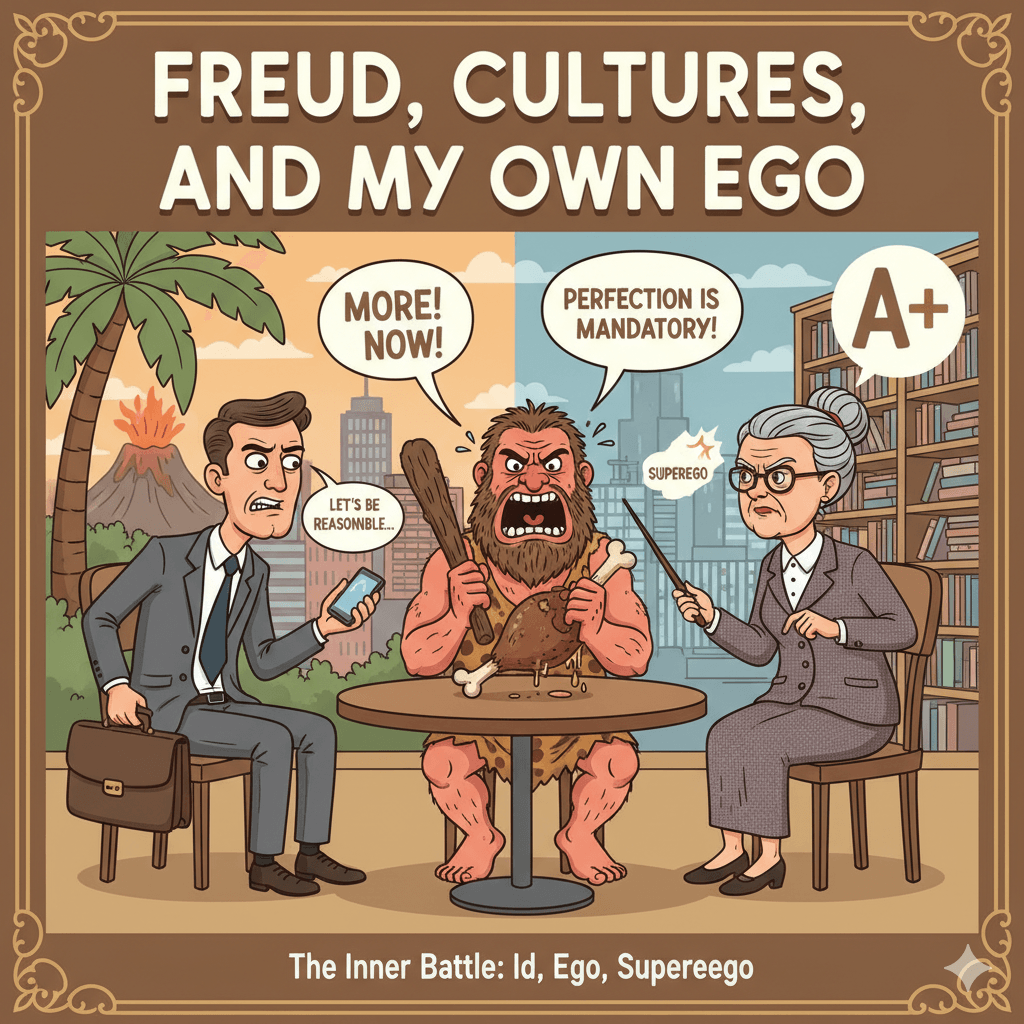
Freud's trio, in my less clinical language.
If desire controls every decision, life becomes impulsive. If moral judgment controls every thought, life becomes a permanent trial. The ego tries to find a workable path between them.
"Workable" matters more than "perfect."

The argument inside one head.
Freud's German Was More Personal
Freud wrote das Es, das Ich, and das Uber-Ich. These terms mean the It, the I, and the Over-I.
The familiar Latin terms came through the English translation by James Strachey. They sound technical and distant. Freud's German sounds more like an internal conversation: the thing that wants, the self that acts, and the authority above the self.
That difference changes how I read the model. "Ego" sounds like a concept from a textbook. "The I" sounds like me, stuck between appetite and judgment on an ordinary Tuesday.

The three forces negotiate over a drink.
A Risky Analogy About Cultures
This is where I leave Freud and start speculating.
Can a culture reward one of these forces more than the others? A society can celebrate pleasure, demand restraint, or praise moderation. Families, churches, schools, employers, and laws all teach people which desires are acceptable.
My first version of this idea was too neat. I put Denmark in the balanced box, the Balkans in the id box, and East Asia in the superego box. That makes a catchy diagram. It also turns millions of different people into three cartoons.
Still, the contrast came from experiences that felt real to me.
In the Balkans, public life can feel loud, social, emotional, and tolerant of excess. Food, alcohol, cigarettes, arguments, and hospitality occupy visible space. That does not mean Balkan people lack discipline. It means that appetite often appears in public without much apology.
During my time in Taiwan, I noticed stronger pressure around education, work, duty, and social expectations. Pleasure did not disappear. It often moved into accepted outlets or private habits. That does not describe all Taiwanese people, and it does not describe all of East Asia.
Denmark looked calmer from the outside. Restraint and comfort seemed able to coexist. But an outsider can mistake social quiet for inner peace. Every culture hides costs from visitors.
So I no longer see cultures as id-heavy or superego-heavy personalities. I see them as environments that reward some behaviors and punish others. The model becomes a question, not a verdict:
What does this culture permit people to want, and what does it teach them to feel guilty about?
That question is less tidy. It is also more honest.
The Part That Is Actually About Me
The cultural theory probably interests me because I recognize both extremes in myself.
Part of me wants the Balkan version of freedom: eat, drink, smoke, laugh loudly, and deal with tomorrow when it arrives. Another part wants achievement without limit. Work harder. Earn more. Build more. Do not become comfortable.
Neither voice knows when to stop.
The first can turn pleasure into avoidance. The second can turn ambition into self-punishment. Calling one side bad and the other good misses the problem. Both can run away with the steering wheel.
Balance is not a permanent personality trait. It is repeated negotiation. Some days the ego does its job well. On other days, desire or judgment wins before the discussion starts.
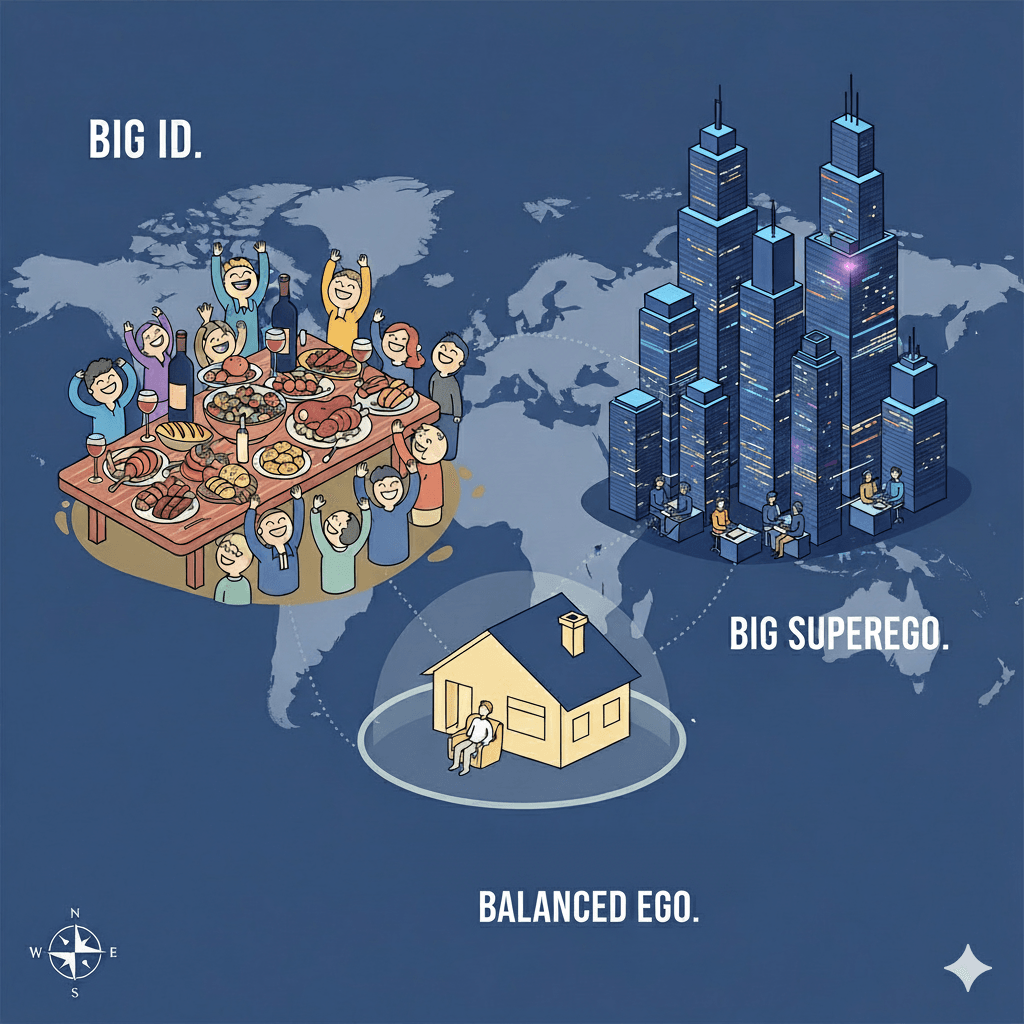
An old attempt to put the idea on a map.
What I Keep From Freud
Freud's model is not proven neuroscience. It cannot diagnose a person or explain a country. Used that way, it becomes fake precision.
I still find it useful as a metaphor. It gives names to desire, judgment, and practical compromise. More importantly, it makes me ask which voice is speaking before I obey it.
The goal is not to kill the id or silence the superego. A life without desire is dead. A life without standards is empty. The hard part is building an ego strong enough to hear both without becoming a servant to either.
That is less exciting than "Balkans are id, Asia is superego."
It is probably closer to the truth.